
By Peter Agbesi Adivor
Africa’s 2026 elections will unfold against the backdrop of
a complex but instructive 2025 electoral year. Several 2025 contests revealed
persistent concerns around political inclusion, institutional independence, and
civic space on the African continent, highlighted by electoral outcomes in Tanzania,
Guinea, and Côte d’Ivoire.
These dynamics underscore recurring structural pressures on
electoral integrity across parts of the continent. At the same time, countries
with more established electoral systems demonstrated relative stability,
reaffirming that Africa’s democratic landscape remains uneven but dynamic.
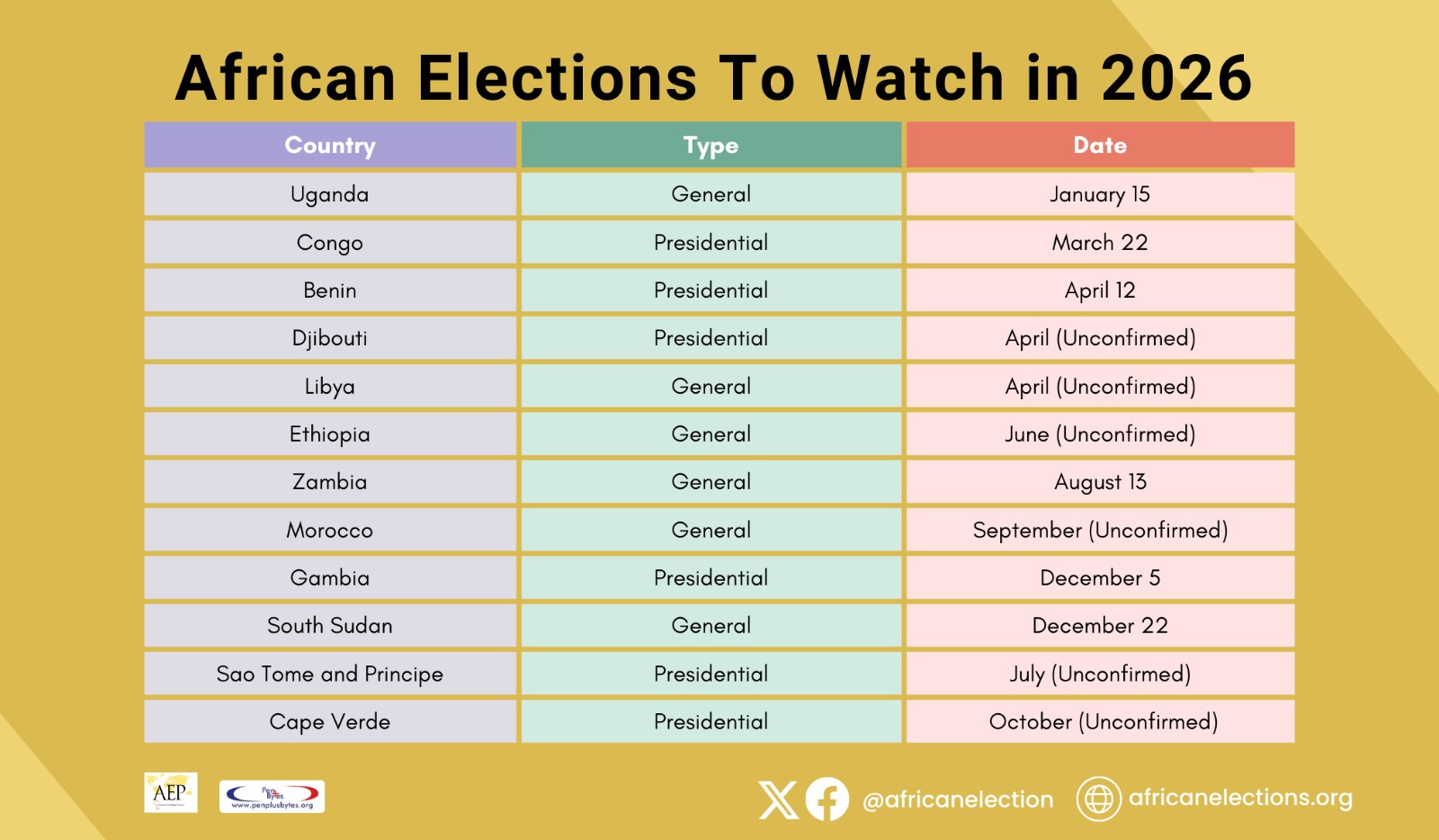
This context helps frame expectations for 2026: a year featuring 10 significant general and presidential elections, each shaped by distinct constitutional, political, and security issues.
Uganda – General Election (15 January 2026)
Incumbent President Yoweri Museveni has been in power since
1986 and seeks yet another term. Reports of opposition arrests, campaign
interference, and limitations on assembly continue to shape perceptions of the
political environment in Uganda.
Opposition fragmentation, limited political space, and a security
force that is loyal to the establishment suggest risks for credible,
competitive outcomes.
Electoral competitiveness is expected to remain constrained,
with attention centered on the independence of the Electoral Commission, the
conduct of security agencies, and space for opposition mobilization.
Benin – Presidential Election (12 April 2026)
Benin was once regarded as a regional democratic model, but
the past few cycles have raised concerns over political inclusion, especially
in relation to opposition access and restrictive electoral reforms.
Benin’s elections will occur under a constitutional
framework that prohibits term amendments beyond two terms for presidents, and
President Patrice Talon has signaled he will not seek a third term.
However, recent legal actions, including the barring of
major opposition parties from contesting, highlight central concerns about
electoral inclusion and political pluralism leading into 2026. The election
also comes against a backdrop of an attempted coup in December 2025 which was
foiled with help from ECOWAS
regional powers.
A scheduled parliamentary election in January will set the
tone for the presidential contest in April. The credibility of that process and
the independence of the electoral commission will be key in determining the
degree of competition and legitimacy of the April presidential race.
Ethiopia – General Election (1 June 2026)
Ethiopia’s elections will be the first general elections
since ongoing political reforms and shifts in the federal system under Prime
Minister Abiy Ahmed. The country’s political context remains shaped by
post-conflict recovery efforts, regional tensions, and debates over federal
governance. Electoral readiness varies significantly across regions.
Ethiopia’s incumbent Prosperity Party and the parties it
succeeded have consistently won general elections overwhelmingly since 1995 through
political repression, rigging and other exclusionary tactics.
Credibility concerns, particularly in conflict-affected
regions with diverse ethnic federal units will pose a challenge to the conduct
of the election. The degree to which elections are inclusive of all regions and
opposition stakeholders will be a critical measure of democratic progress or
regression in Ethiopia.
Zambia – General Election (13 August 2026)
Zambia is viewed as one of the region’s more competitive
democracies. The 2026 contest will test the incumbency of President Hakainde
Hichilema amid economic pressures and evolving political alliances.
Zambia’s electoral integrity is comparatively robust, but
economic performance and governance issues will be decisive for voter behavior.
In a move that critics argue is intended to bolster his
electoral fortunes ahead of the election according to critics, President
Hichilema has bolted into action, signing a new law expanding parliamentary
seats from 167 to 280 with seat allocations for women, youth and PWD candidates.
Despite a fragmented opposition and incumbency advantage, Hichilema’s
prospects for a second term will be contingent on public perceptions of
economic governance, youth employment, and service delivery.
The Gambia – Presidential Election (5 December 2026)
The Gambia will hold its presidential election with
incumbent Adama Barrow running for what would be a third term. This election
will test institutional stability, especially given The Gambia’s democratic
consolidation since the 2016 political transition.
Barrow rose to power in 2017 after beating Yahya Jammeh who
refused to hand over power before fleeing the country under pressure. Although
permitted by the country’s constitution, many people did not expect Barrow to
run for a third term considering the history behind how he assumed power.
However, Barrow
remains the favorite in this election as the opposition led by Ousainou
Darboe struggles to put forward a formidable opposition to challenge Barrow’s
candidacy.
South Sudan – General Election (22 December 2026)
South Sudan’s election is historically significant as the
first national electoral exercise since independence. It has been repeatedly
delayed due to civil conflict, governance weaknesses, and peace process
requirements.
The management of the election itself faces many structural
hurdles including uncertainty over constituencies and delays in conducting a
national census which would allow the National Elections Commission to properly
plan the vote. In December 2025, the Commission resolved to use a 2010
constituency set-up which predates the country’s independence to conduct the
election as permitted by the election’s legal framework.
As the country’s leadership puts the pieces together towards
making the long-delayed election a reality, credibility of voter registration,
civic freedoms, and the political accommodation of all signatory parties will
determine whether the process supports stability or further inflames tensions
in the volatile East African state.
Congo – Presidential Election (March 22, 2026)
The Republic of the Congo heads into its 2026 presidential
election under a long-standing pattern of political continuity dominated by
President Denis Sassou Nguesso, who has governed for over four decades across
two periods. His nomination by the ruling Congolese Labour Party (PCT) for
another term reinforces the entrenched incumbency framework, supported by broad
institutional control and a co-governing parliamentary majority.
Despite this dominance, the opposition landscape has shown signs of increased coordination. In 2025, 17 opposition groupings endorsed a joint manifesto calling for democratic alternation, leading to the emergence of broader platforms such as the Alliance for Democratic Alternation in 2026.
However, these efforts face significant challenges, including limited resources
against a well-resourced incumbent, restricted civic space, and risks
highlighted by incidents such as the kidnapping of opposition figure Lassy
Mbouity, which raised concerns over political safety and intimidation.
While opposition figures like Destin Gavet and others have
begun to position themselves, no single challenger has yet consolidated
national momentum sufficient to rival incumbent Nguesso leaving the
establishment all set to potentially continue its reign.
Djibouti – Presidential Election (April 2026,
Unconfirmed)
Djibouti maintains a centralized political system with
limited opposition competition. Past elections have been peaceful but tightly
controlled. Continuity of the regime is expected as the country adopted
constitutional revisions which removed age limits paving the way for President
Ismail Omar Guelleh who has been in power since 1999 to seek a sixth term
in 2026.
Guelleh’s party currently holds majority in Djibouti’s
parliament and won the last elections with 97% of the votes. If successful at this year's polls, the
People’s Rally for Progress (RPP) leader will join the likes of Cameroon’s Paul
Biya and Cote D’ivoire’s Alassane Outtara as one of the oldest African leaders
still holding onto power by systemically bending the rules to remain in office.
Libya – General Elections (April 2026, Unconfirmed)
Libya’s elections continue to depend heavily on security
conditions, political dialogue outcomes, and the ability of institutions to
reach consensus on the legal framework.
Stemming from the fall of Muammar Gaddafi, Libya’s political
leadership has been heavily divided with the internationally recognized
Government of National Unity (GNU) based in Tripoli in the northwest and the
Government of National Stability (GNS) in Benghazi in the east. This division
and the struggle for control by rival factions have made it difficult to
conduct elections.
The Libyan High National Elections Commission (HNEC)
announced in December that it has started preparations for holding presidential
and parliamentary elections in mid-April 2026. The commission said it has begun
preparing and publishing the regulatory frameworks for the elections of the
head of state and the parliament and is drafting the regulations governing
nominations for prospective candidates.
HNEC has also urged the UN Support Mission in Libya to
accelerate efforts to resolve disputes surrounding amendments to electoral laws
proposed by the “6+6 Committee” that is composed of six members of the House of
Representatives and six members of the High Council of State charged with
developing the legislative framework for the elections.
Uncertainty remains high as the feasibility of holding
credible elections hinges on stabilizing the political process between rival
administrations and ensuring a unified electoral framework in the volatile
North African country.
Morocco – General Elections (September 2026, Unconfirmed)
Morocco is preparing for its legislative elections scheduled for September 2026. Political consultations between the government and parties were initiated in 2025 under royal directives from King Mohammed VI to establish a stable legal framework for the election, reflecting the monarchy’s guiding role in Morocco’s hybrid political system.
The electoral cycle will
determine the composition of the House of Representatives, directly shaping the
next government and premiership under Morocco’s constitutional monarchy.
The current political context is defined by a multiparty landscape where the ruling coalition, led by the National Rally of Independents (RNI) under Prime Minister Aziz Akhannouch, faces growing pressures for reform and renewal.
In response to public demand for greater political inclusion,
authorities have enacted electoral
reforms aiming to enhance participation, particularly for youth and women
candidates and to modernise party structures and financing ahead of the 2026
vote.
Key expectations for the 2026 elections include intensified
competition among established parties such as the RNI, Authenticity and
Modernity Party (PAM), Istiqlal, Justice and Development Party (PJD), and
others vying for parliamentary influence. Analysts caution that political
tensions may rise as coalition negotiations and local council disputes unfold,
with potential implications for legislative stability and governance cohesion
after the vote.
Persistent challenges such as voter apathy, debates over diaspora participation, and calls to expand political rights are shaping public discourse and could influence turnout and campaign strategies.
Ultimately, the
2026 elections will be a critical test of Morocco’s evolving electoral
institutions and the broader trajectory of political inclusion and democratic
practice within the kingdom.
Sao Tome and Principe - Presidential (Unconfirmed)
São Tomé and Príncipe is scheduled to hold its presidential election in 2026 as part of the country’s general election cycle. This year’s election will renew both the executive and legislative branches in the small Gulf of Guinea island state, which has a history of competitive multiparty politics and peaceful transfers of power relative to the region.
The president
serves as head of state for a five-year term, and the unicameral National
Assembly’s 55 seats are elected every four years by proportional
representation.
São Tomé and Príncipe is widely viewed as one of Central
Africa’s more stable multiparty democracies, with a functioning semi-presidential
system that has enabled peaceful elections and alternations of power since the
early 1990s. Its constitution limits the president to two consecutive five-year
terms, and mechanisms for executive-legislative balance have helped sustain
competitive politics.
However, political institutions remain fragile, and
governance performance is often hampered by internal disagreements among
elites. The dissolution of the government in January 2025 by President Carlos
Vila Nova, who dismissed Prime Minister Patrice Trovoada over governance
concerns, illustrates this fragility within the ruling party and broader
political class - a factor that may carry into electoral competitiveness in
2026.
Economic conditions are a significant backdrop to the 2026
elections. São Tomé and Príncipe faces macroeconomic vulnerabilities, including
a narrow export base, reliance on imports and external assistance, low
reserves, and structural challenges typical of small island developing states. Continued
emphasis on inclusive economic growth - particularly for youth and vulnerable
groups is a key political issue that parties are expected to address during the
campaign.
These contextual factors suggest that the 2026 elections
will not only test electoral competitiveness but also the broader capacities of
the São Toméan state to address economic discontent, implement reforms, and
sustain democratic consolidation.
Cape Verde - Presidential (October Unconfirmed)
Cape Verde is scheduled to hold its presidential election in
October 2026. The president is elected for a five-year term using a two-round
system.
The current president, José Maria Neves (African Party for
the Independence of Cape Verde, PAICV), won the 2021 presidential poll in the
first round with over 51% of the vote, marking the first PAICV presidential
victory since 2006. His tenure has been set within a cohabitation political
arrangement, where the PAICV presidency coexists with a legislative majority
held by the Movement for Democracy (MpD) led by Prime Minister Ulisses Correia
e Silva.
The December 2024
municipal elections saw the PAICV achieve strong gains at the local level,
suggesting shifts in political momentum that may influence voter behaviour and
campaign strategies ahead of the national polls.
The 2026 presidential contest will therefore be shaped by
established party competition between the PAICV and the MpD, governance
achievements and frustrations since 2021, and voters’ assessment of leadership.
Conclusion
The 2026 African electoral cycle will be significant for the democratic trajectory of the continent. Building on the mixed outcomes of the 2025 elections, from credible contests to disputed processes, the electoral landscape of 2026 is poised to test the resilience of electoral institutions, political inclusiveness, and democratic norms.
The quality and legitimacy of elections in
Uganda, Benin, Ethiopia, Zambia, Congo, The Gambia, and South Sudan, as well as
the feasibility and inclusiveness of processes in Djibouti, Libya, and Morocco,
will not only redefine national governance outcomes but also influence regional
democratic expectations.
For election assistance programs, international observers, and civil society stakeholders, investment in electoral integrity, political freedoms, and dispute resolution mechanisms will be decisive for credible, peaceful and competitive elections in 2026.
Africanelections.org
 Take Voters' Compass